The World Upside Down:
Antipodism
Antipodism is not a style name that Briels was assigned from the outside. It is a concept he formulated himself to describe what he had been doing for years: merging two extremes into a whole that is greater than the sum of its parts.
Origin and Meaning
The word antipode refers to two points that are diametrically opposite each other on a sphere. Briels uses that image for his view on art: seriousness and humor, intimate emotion and monumental scale, simplicity and complexity. Those combinations do not conflict in his work, they reinforce each other.
Briels introduced Antipodism as his own movement in his adult career, after he had built a figurative foundation in the Netherlands. The style is unmistakable: expressive human figures, color palettes that do not copy reality but follow an emotional logic, compositions that tell multiple stories simultaneously. Every work invites re-reading.
Influences: From COBRA to the Caribbean
The COBRA movement (1948–1951) showed that European artists could work outside academic frameworks: expressive, intuitive, without a hierarchy between figure and background. Briels shares that freedom, but added a layer of narrative and humor that COBRA generally lacks. His figures are not spontaneous forms, they carry roles, postures, a point of view.
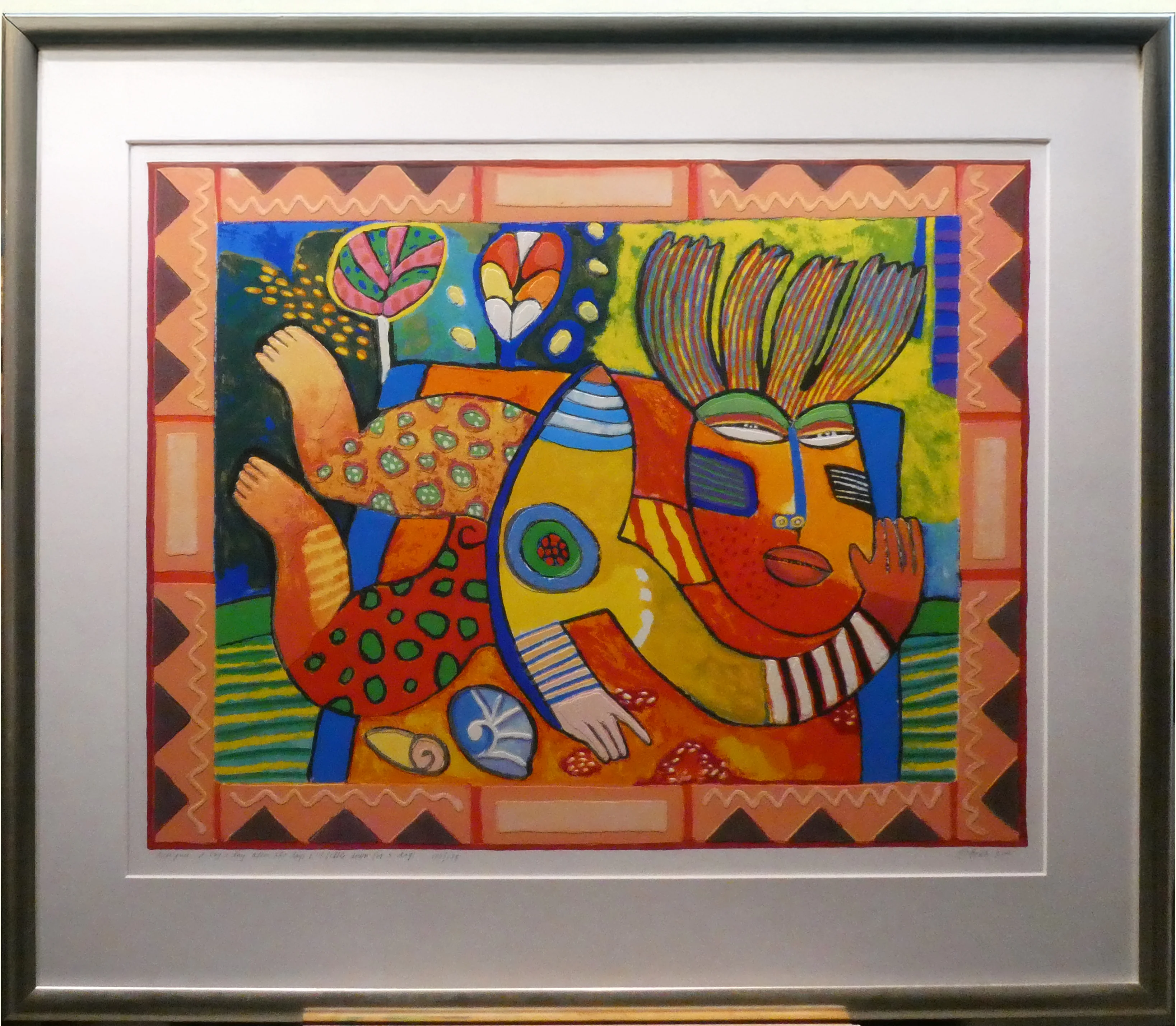
The Latin American influence is concrete and documentable. Briels worked and exhibited in the Caribbean and Latin America, and this is reflected in his use of color and composition. The screen print Antigua, a bay a day from 2000 (edition 132 of 175 pieces, 95 by 110 centimeters) is direct proof of this: tropical colors, a rhythmic composition, the atmosphere of an island that shows a new face every day. A museum exhibition in Shanghai followed in 2008. His work exhibited on five continents.
Media and Technique
Briels works in multiple media, and that is not an artistic statement but a practical choice: each medium exposes a different characteristic of his visual language.
With his screen prints, colors are applied layer by layer, each color a separate print run. This is clearly visible in the collection: Algunos Gentes Hacen la Comedia (color screen print 97/175, 104 by 155 cm, 2005) has a color depth that you only understand when you view the work up close. The layers are not perfectly aligned; that slight shift is part of the process.
The 3D wall object Yellow Beard of Vegas (acrylic on resin, 49 by 49 by 7 cm, 2000, edition 4/50) shows another side. The resin gives a reflection that is impossible on canvas, and the 7 centimeters of depth makes the work a presence in the room rather than a flat image.
A Briels in your home is a work that you see differently depending on the light, the time of day and your own mood. That is exactly what he intends.
Antipodism in the Collection
Every work in our collection is a living example of the Antipodism philosophy. Below are three works and what they embody.

You Carved Out Your Name
Antipodism is about contrasts that reinforce each other. In this work, the intimacy of a personal feeling, love that carves itself in, collides with the monumental scale of the canvas (130x100cm). The result is raw and optimistic at the same time.
View this workAlgunos Gentes Hacen la Comedia
Antipodism declares that people can never be fully grasped. "Some play comedy, others don't". Briels shows this in a panoramic screen print of 104x155cm, full of figures each inhabiting their own reality. Typical Briels: humor as a philosophical instrument.
View this work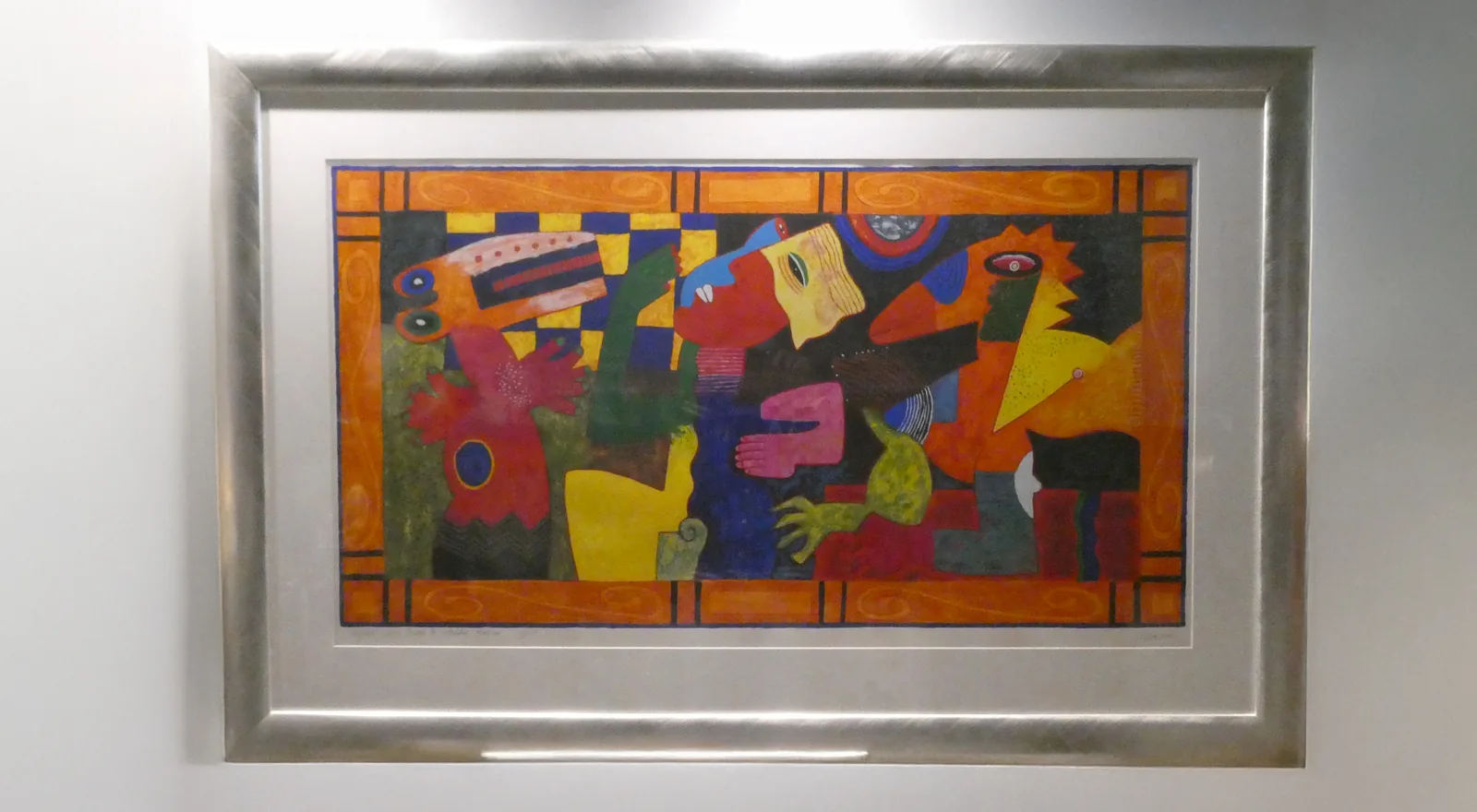
Antigua, a Bay a Day
The Caribbean as a source of inspiration: rhythm, color, the tension between bustling life and the silence of the sea. Briels captures this in a screen print with a Latin American feel. The composition reads like music, each element in dialogue with the next.
View this workFrequently asked questions about Antipodism
What is Antipodism?
Antipodism is an art style created by the Dutch artist Clemens Briels (1946), in which opposites are combined into a dynamic, colourful and optimistic image. Characteristic are explosive colour oppositions, expressive figures and humorous compositions about human existence.
Where does the term Antipodism come from?
The word antipode refers to two points diametrically opposite each other on a sphere. Clemens Briels coined the term himself to describe his artistic outlook: seriousness and humour, intimate emotion and monumental scale, simplicity and complexity that do not oppose but reinforce each other.
What is the influence of CoBrA on Clemens Briels' Antipodism?
The CoBrA movement (1948-1951) showed that European artists could work outside academic frameworks: expressive and intuitive, without hierarchy between figure and background. Clemens Briels shares that freedom, but adds a layer of narrative and humour that CoBrA usually lacks.